
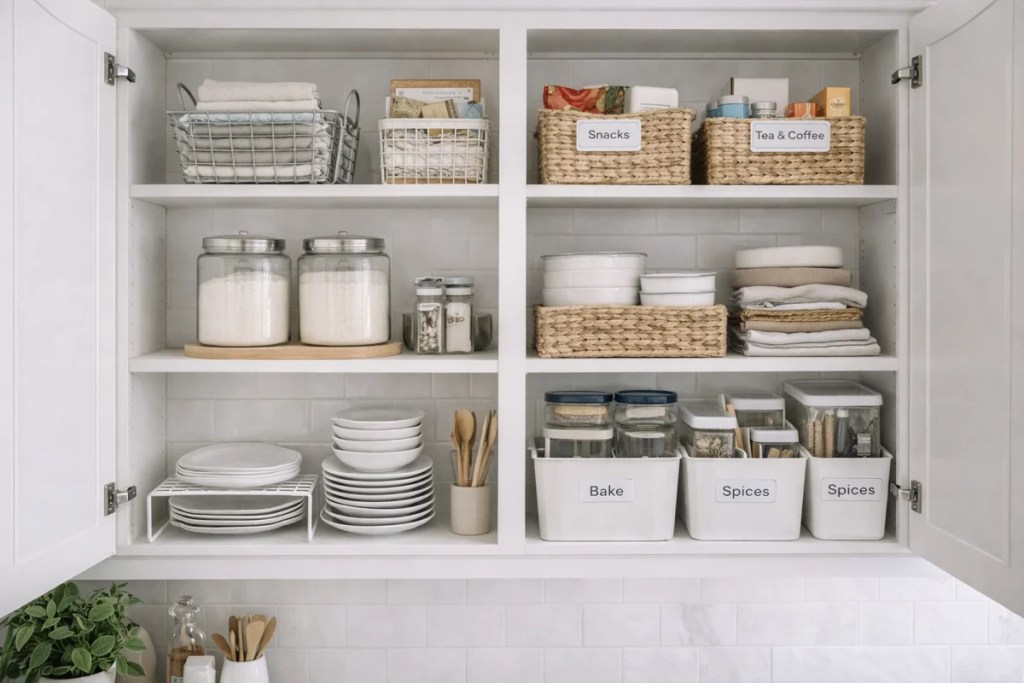
You open your kitchen cabinet to grab something simple… and suddenly you’re moving three things just to reach one.
A container slides. Something in the back gets stuck. And by the time you close the door, it already feels slightly messy again.
That’s how most cabinets work.
Not because they’re small—but because they’re not set up for real use.
👉 Cabinets usually fail in one place: access.
If you can’t reach things easily, the system breaks. And once it breaks, everything slowly turns into a pile.
This isn’t about making your cabinets look perfect.
👉 It’s about making them easy to use on a normal day.
Start by Seeing the Problem Clearly
Before organizing anything, don’t just empty the cabinet—pay attention.
Notice:
- what you reach for first
- what you avoid touching
- what gets pushed to the back
Most clutter patterns repeat themselves.
And if you don’t notice them, you’ll rebuild the same mess again.
Stop Treating Cabinets Like Storage Boxes
This is where most setups go wrong.
Cabinets are not long-term storage.
They are:
👉 active-use spaces
If something stays there but you rarely touch it:
- it blocks access
- it creates layers
- it adds friction
Move those items somewhere else.
Keep cabinets for things you actually use.
Make Front Space Valuable
The front of your cabinet is your most important area.
That’s where:
- your hand naturally goes
- your eyes land first
So instead of filling it randomly:
👉 reserve it for daily items
This one change alone makes cabinets feel easier instantly.
Don’t Stack Without Thinking
Stacking feels efficient—but it hides problems.
When you stack:
- lower items disappear
- everything shifts when you grab one thing
- the back becomes unreachable
Instead of stacking more:
👉 stack less, but smarter
Keep important items visible.
Common Mistakes That Ruin Cabinets
❌ Using cabinets for “just in case” items
They slowly block useful space.
❌ Filling every empty spot
Makes access harder, not better.
❌ Ignoring how you actually use things
Leads to systems that don’t last.
Use Depth Intentionally (Not Blindly)
Most cabinets have depth—but that depth is usually wasted.
What happens in real life?
👉 The front gets used
👉 The back turns into storage you don’t touch
Over time, the back becomes a place where things go… but rarely come back.
Instead of treating the cabinet as one space, split it mentally:
- Front → daily items
- Back → secondary items (but still reachable)
And here’s the key:
👉 If you can’t reach it without moving things, it’s too far.
That’s the moment when a cabinet stops working and starts becoming storage.
Make Everything One-Move Accessible
This is one of the simplest ways to test your setup:
👉 Can you grab what you need in one move?
If not:
- you’re stacking too much
- or you’re placing things in the wrong order
Real-life use is fast.
No one wants to:
- lift containers
- move stacks
- dig through layers
So build your cabinet like this:
👉 open → grab → done
Anything more than that creates friction.
Group by Behavior, Not Category
Most advice says “group similar items.”
That’s not always enough.
Instead, think like this:
👉 group based on how you use things
For example:
- coffee items together (not just “cups” vs “tools”)
- cooking essentials together (not separate categories)
This reduces movement.
You don’t think in categories when you cook—you think in actions.
Your cabinet should match that.
Leave Space on Purpose
This sounds wrong at first—but it’s one of the biggest upgrades.
👉 not every space needs to be filled
When a cabinet is full:
- items get stuck
- things shift constantly
- small messes grow faster
When there’s a little space:
- things move easily
- you don’t break the system every time you use it
Empty space is not wasted.
👉 It’s what makes the system work.
Stop Solving Problems with More Storage
When cabinets feel messy, the instinct is:
👉 “I need organizers”
But most of the time, the real issue is:
- too many items
- wrong placement
- poor access
Adding more storage without fixing these:
👉 just hides the problem
Fix the structure first.
Reset the Cabinet While You Use It
Most people wait until cabinets get messy.
That’s too late.
Instead, do micro-resets:
- adjust items after using them
- fix small shifts immediately
- don’t let things pile up
It takes seconds—but prevents bigger problems.
💬 What I Personally Recommend (What Actually Made My Cabinets Work)
For a long time, my cabinets looked “organized”… but didn’t feel easy.
Everything had a place. It looked fine from the outside.
But in real use?
I still had to:
- move things
- reach around items
- adjust things every time
That’s when I realized something simple:
👉 looking organized and working smoothly are not the same thing.
So I stopped trying to make my cabinets look perfect.
I started focusing on how they felt to use.
Here’s what I personally recommend if you want your cabinets to actually work:
1. Test your cabinet in real use (not in theory)
Open it. Grab something. Put it back.
If it feels slightly annoying—even a little—that’s where the problem is.
Don’t ignore that feeling. That’s exactly where friction lives.
2. Reduce until movement feels easy
Not until it “looks minimal.”
Until:
👉 your hand moves freely
👉 nothing gets in the way
👉 nothing needs adjusting
That’s the real goal.
3. Prioritize flow over logic
Logical categories don’t always work in real life.
Instead, ask:
👉 “What do I reach for together?”
Build around that.
4. Don’t fix everything—fix what annoys you most
You don’t need a full reset.
Start with:
- the cabinet you open the most
- the one that feels frustrating
Fix that first.
You’ll feel the difference immediately.
And one rule that changed everything for me:
👉 If I hesitate before grabbing something, the setup is wrong.
That hesitation is small—but it tells you everything.
Fix that, and the whole system improves.
Now my cabinets aren’t “perfect.”
But I don’t think about them anymore.
I open, use, and close—without effort.
And that’s what actually matters.
⚡ Quick Cabinet Reset (That Actually Sticks)
Instead of waiting for a full mess:
👉 do a fast reset when something feels off
- adjust one section
- remove one unnecessary item
- fix one friction point
Not everything.
Just one thing.
That’s enough to keep the system working.
🧾 Conclusion
Kitchen cabinet organization isn’t about fitting more inside.
It’s about removing friction.
When everything is easy to reach, easy to use, and easy to put back—your cabinets stop feeling like storage and start working like a system.
You don’t need perfect layouts or extra products.
👉 You just need a setup that matches how you actually use your kitchen.
Start with one cabinet. Fix what feels off.
And build from there.
❓ FAQ (SEO Featured Snippet Ready)
How do I organize deep kitchen cabinets?
Keep daily items in the front, limit stacking, and make sure everything is reachable in one move.
What should go in kitchen cabinets?
Only frequently used kitchen items. Rarely used items should be stored elsewhere.
How do I stop cabinets from getting messy?
Reduce the number of items and fix small disorganization immediately.
Do I need cabinet organizers?
Not always. Most problems come from too many items and poor placement—not lack of organizers.