
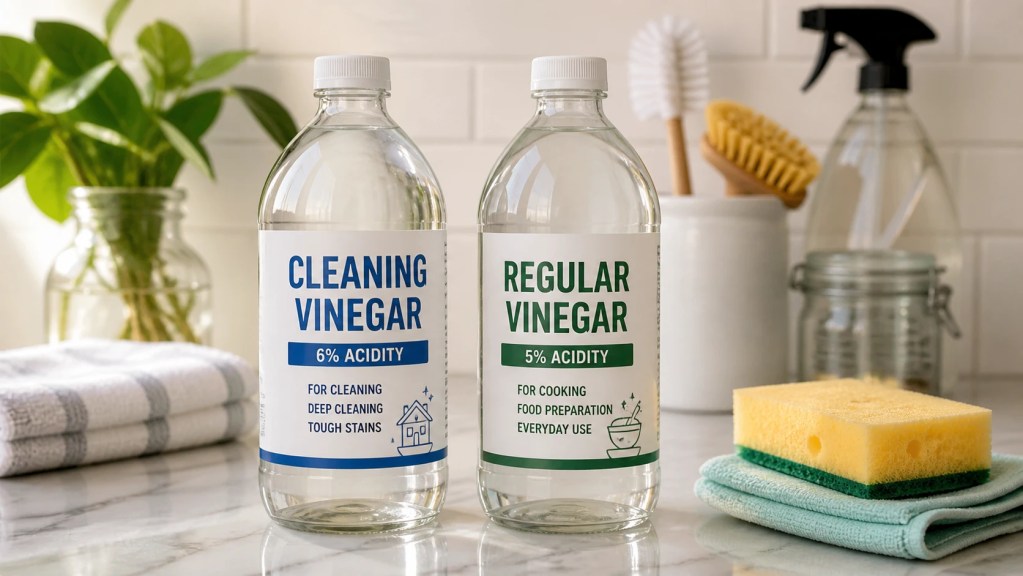
Most people assume cleaning vinegar and regular white vinegar are basically the same product. They look similar, smell similar, and are both commonly used around the house. But once you actually start cleaning with them, the differences become much more important than most people realize.
Cleaning vinegar is stronger, more acidic, and designed specifically for tougher household cleaning tasks. Regular white vinegar is milder and originally intended for cooking and food preparation. That difference affects cleaning power, surface safety, smell intensity, and even the risk of damaging certain materials in your home.
Understanding the difference between cleaning vinegar vs white vinegar matters because using the wrong type in the wrong situation can lead to poor cleaning results — or unnecessary surface damage.
In this guide, we’ll compare cleaning vinegar and white vinegar side by side, explain where each one works best, and cover the most common mistakes people make when using vinegar for household cleaning.
Cleaning Vinegar vs White Vinegar at a Glance
| Feature | Cleaning Vinegar | Regular White Vinegar |
|---|---|---|
| Acidity Level | Usually 6% | Usually 5% |
| Primary Use | Household cleaning | Cooking & light cleaning |
| Cleaning Strength | Stronger | Milder |
| Food Safe | ❌ No | ✅ Yes |
| Better for Hard Water | ✅ Yes | ⚠️ Sometimes |
| Safer for Delicate Surfaces | ❌ Less safe | ✅ Slightly safer |
| Smell Intensity | Stronger | Milder |
| Risk of Surface Damage | Higher if overused | Lower but still possible |
What is cleaning vinegar?
Cleaning vinegar is a stronger version of vinegar made specifically for household cleaning tasks. Unlike regular white vinegar used in cooking, cleaning vinegar contains a higher acidity level — usually around 6% acidity instead of the typical 5% found in standard white vinegar.
That small difference may not sound significant at first, but it noticeably changes how the vinegar behaves during cleaning. Cleaning vinegar breaks down mineral deposits, soap scum, grease, and hard water buildup more aggressively than regular vinegar.
Because of the stronger acidity, cleaning vinegar is commonly used for:
* hard water stains
* soap scum buildup
* shower doors
* sinks and faucets
* glass cleaning
* mineral residue removal
At the same time, stronger acidity also means stronger risk if it’s used incorrectly. Cleaning vinegar can damage certain surfaces more quickly, especially natural stone, delicate finishes, coated electronics, rubber seals, and some metal surfaces.
This is where many people get confused. Since vinegar is often described as “natural,” people assume it is automatically safe for every cleaning task. In reality, both cleaning vinegar and regular white vinegar can damage surfaces if used improperly — cleaning vinegar simply does it faster because it is more acidic.
What is regular white vinegar?
Regular white vinegar is the standard vinegar most people already have in their kitchen. It is primarily made for cooking, food preparation, pickling, and baking, although many people also use it for light household cleaning.
Compared to cleaning vinegar, regular white vinegar is slightly less acidic. Most bottles contain around 5% acidity, which makes it somewhat gentler for everyday cleaning tasks.
That lower acidity level is one reason many homemade vinegar cleaning recipes still rely on regular white vinegar instead of cleaning vinegar. It usually works well for lighter cleaning tasks such as:
mild kitchen cleaning
deodorizing certain surfaces
removing light water spots
simple homemade cleaning sprays
wiping glass and mirrors
However, many people expect regular vinegar to handle heavy-duty buildup that actually requires stronger cleaning power. When the results feel weak, they often keep applying more vinegar without realizing the issue is strength rather than quantity.
In reality, choosing between cleaning vinegar vs white vinegar depends more on the surface and the type of cleaning problem than most people realize.
Cleaning Vinegar vs White Vinegar: Side-by-Side Comparison

At first glance, cleaning vinegar and regular white vinegar seem almost identical. Both are clear liquids, both have a strong smell, and both are commonly used around the home. That’s why many people assume the only difference is the label on the bottle.
But once you actually start cleaning with them, the differences become much more noticeable.
The biggest difference between cleaning vinegar vs white vinegar is acidity strength. Cleaning vinegar is specifically designed for tougher household cleaning tasks, while regular white vinegar is milder because it was originally intended for food preparation and cooking.
That extra acidity changes several things:
how quickly buildup dissolves
how aggressive the vinegar feels on surfaces
how strong the smell becomes during cleaning
how much caution is needed on delicate materials
For example, cleaning vinegar usually works faster on hard water stains around sinks, faucets, shower doors, and tile buildup. In many situations, it reduces scrubbing effort because the stronger acidity breaks down mineral deposits more aggressively.
Regular white vinegar works more slowly, but for lighter cleaning jobs, that is often completely fine. In fact, many people actually prefer it because the smell is slightly less intense and the lower acidity feels safer for routine household cleaning.
Where people often make mistakes is assuming stronger vinegar automatically means better cleaning everywhere.
That is not how it works in real-life cleaning.
A stronger acidic solution may clean faster, but it can also increase the risk of damaging sensitive surfaces if used repeatedly or incorrectly. Natural stone, coated surfaces, electronic screens, finished wood, rubber seals, and certain metals are common examples where stronger vinegar can create problems over time.
Cleaning Vinegar vs White Vinegar Comparison Table
| Feature | Cleaning Vinegar | Regular White Vinegar |
|---|---|---|
| Acidity Level | Usually 6% | Usually 5% |
| Main Purpose | Household cleaning | Cooking & light cleaning |
| Cleaning Strength | Stronger | Milder |
| Food Safe | ❌ No | ✅ Yes |
| Better for Hard Water | ✅ Yes | ⚠️ Sometimes |
| Better for Soap Scum | ✅ Yes | ⚠️ Moderate |
| Smell Intensity | Stronger | Milder |
| Risk on Delicate Surfaces | Higher | Lower |
| Safe for Cooking | ❌ No | ✅ Yes |
| Best For | Heavy buildup & mineral deposits | Everyday light cleaning |
Can You Clean With Regular White Vinegar?
For everyday maintenance, standard white vinegar is often strong enough to handle light dirt, mild grease, water spots, and odor control. That is one reason homemade vinegar cleaning recipes became so popular in the first place. The ingredients are inexpensive, simple, and easy to use around the home.
Regular white vinegar is commonly used for:
glass and mirrors
light kitchen cleaning
mild bathroom residue
deodorizing trash cans
simple homemade cleaning sprays
For lighter cleaning tasks, regular vinegar is usually enough without feeling overly harsh.
However, this is where many people misunderstand how vinegar works.
Some people try regular vinegar on extremely heavy buildup and assume vinegar “doesn’t work” when the results are weak. In reality, the issue is often that the cleaning problem requires either:
stronger acidity
more cleaning time
a completely different cleaning product
Another important factor is frequency.
Using regular vinegar occasionally is very different from spraying acidic solutions on the same surface every single day. Repeated exposure is where long-term problems often begin to appear. Certain materials slowly lose their protective finish over time, even if the damage is not obvious immediately.
That’s why understanding surface compatibility matters just as much as understanding cleaning strength.
Where Cleaning Vinegar Actually Works Better
This is especially common in moisture-prone areas such as:
shower doors
faucets
tile buildup
sink edges
hard water stains
soap scum residue
In these situations, the stronger acidity in cleaning vinegar can noticeably reduce scrubbing effort because it breaks down buildup more aggressively than regular white vinegar.
For example, cleaning vinegar often works faster on thick mineral deposits around faucets or cloudy hard water stains on glass shower doors. In many cases, it softens buildup enough to make cleaning significantly easier.
This is one reason searches for cleaning vinegar vs regular vinegar have increased so much recently. More people are realizing that not all vinegar behaves the same way during cleaning.
At the same time, stronger cleaning power also increases the chance of overuse.
One common mistake is switching entirely to cleaning vinegar for every household cleaning task simply because it works faster. But faster cleaning does not automatically mean safer cleaning.
Repeated use of strong acidic cleaners on delicate materials can slowly wear down finishes, protective coatings, rubber components, and sensitive surfaces over time.
The safest approach is treating cleaning vinegar as a targeted cleaner rather than a universal solution for the entire house.