
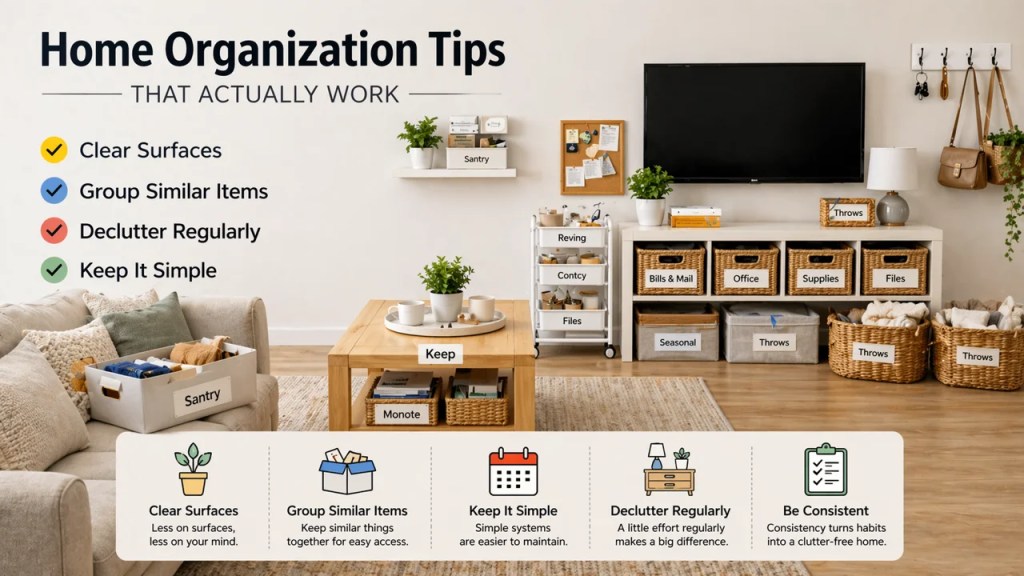
Most home organization advice looks great—until you try to live with it.
Perfect shelves, labeled boxes, aesthetic setups… they look clean in photos. But in real life, they often don’t last. Things slowly move, systems break down, and clutter quietly returns.
The problem isn’t that you’re doing something wrong.
The problem is that most organization systems are not built for real life.
They assume:
- you always have time
- you always follow the system
- you never get busy or tired
But real homes don’t work like that.
Real organization is not about perfection. It’s about creating a system that still works even when life gets messy.
And that’s exactly what we’re going to focus on.
Before You Start Organizing, Understand This
This is where most people go wrong:
👉 They try to organize everything without removing anything.
Organizing too many things just creates a more structured version of clutter.
It might look better for a while—but it doesn’t last.
Before you organize:
- reduce what you keep
- be honest about what you use
- stop keeping things “just in case”
If you skip this step, no system will hold.
Start with One Small Area (Not the Whole House)
Trying to organize your entire home at once usually leads to:
- overwhelm
- unfinished work
- frustration
Instead:
- start with one drawer
- one shelf
- one corner
This gives you quick progress.
And more importantly—it builds momentum.
Focus on Function, Not Looks
A lot of organization advice focuses on how things look.
But what actually matters is how things work.
Ask yourself:
- Is this easy to use?
- Is it easy to maintain?
- Can I keep this system when I’m busy?
If the answer is no, the system will fail—no matter how good it looks.
Common Mistakes People Make When Organizing
This is where most systems break down.
❌ Trying to organize instead of declutter
You don’t need better storage—you need fewer things.
❌ Creating complicated systems
If it takes effort to maintain, it won’t last.
❌ Keeping too many “just in case” items
These slowly fill your space without adding value.
❌ Expecting perfection
No system stays perfect. The goal is control, not perfection.
Small Changes That Instantly Improve Any Space
You don’t need big changes to see results.
Start with:
- clearing one surface completely
- removing 5–10 unnecessary items
- creating one clean, usable area
Even small improvements can change how your home feels.
What Actually Works (In Real Life, Not Just Online)
Most organization advice focuses on perfect systems.
But real homes don’t stay perfect.
What actually works in real life is much simpler:
- fewer items
- easier access
- quick reset systems
If something takes effort, you won’t keep doing it.
That’s the truth most people don’t talk about.
A system that works when you’re tired, busy, or distracted—that’s a real system.
My Simple Rule for Keeping Any Space Organized
This is the one rule that made the biggest difference for me:
👉 If I don’t use it regularly, it doesn’t stay visible.
That’s it.
Not thrown away immediately. Not forced out of your home.
Just not kept in sight.
This simple shift:
- reduces visual clutter
- makes spaces feel bigger
- keeps only useful items accessible
And over time, you naturally keep less.
Use the “One In, One Out” Habit
Clutter doesn’t come back overnight—it comes back slowly.
New items enter your home, and nothing leaves.
A simple habit fixes this:
👉 For every new item, remove one.
This keeps your space balanced without forcing strict minimalism.
Create Simple Zones (Without Overcomplicating It)
You don’t need detailed categories or labels.
Just create basic zones:
- daily-use items
- storage items
- rarely used items
This keeps things structured without making the system harder to maintain.
Simple systems last longer.
Things I Stopped Doing That Changed Everything
This part made a bigger difference than I expected.
I stopped:
- keeping things “just in case”
- buying storage before decluttering
- trying to organize everything perfectly
- holding onto items I didn’t actually use
Once I stopped doing these, everything became easier.
Make Everything Easy to Put Back
This is where most systems fail.
If putting something back is:
- inconvenient
- unclear
- time-consuming
…it won’t happen.
Every item should have:
- a clear place
- easy access
- no friction
If it’s easy to return, it stays organized.
Keep Your Systems Flexible
Life changes. Your routines change.
Your system should adapt.
If something stops working:
- adjust it
- simplify it
- remove unnecessary parts
Organization is not a fixed system—it’s something that evolves with you.
💬 My Personal Take (What Actually Made a Difference Over Time)
For a long time, I thought being organized meant having a perfect system.
Something stable. Something that wouldn’t change. Something that would finally “fix everything.”
That idea was the problem.
Because real life doesn’t stay stable.
There are busy days, lazy days, stressful weeks… and in those moments, even the best-looking systems fall apart.
I used to reorganize things over and over again.
Not because I wanted to—but because nothing lasted.
And at some point, I realized something simple:
👉 The problem wasn’t my effort. It was the system itself.
It required too much from me.
Too much time. Too much discipline. Too much attention.
So I stopped trying to build a perfect system.
Instead, I focused on something else:
👉 making things easier.
I removed more than I added.
I simplified more than I optimized.
I stopped asking:
“How can I organize this better?”
And started asking:
“How can I make this easier to live with?”
That shift changed everything.
Now, things still get messy. That hasn’t changed.
But the difference is:
- it doesn’t get overwhelming
- it doesn’t stay messy
- it’s easy to fix
And that’s what actually works—not perfection, just simplicity.
⚡ The 5-Minute Reset (The Habit That Keeps Everything Together)
If there’s one thing that keeps your home organized long-term, it’s this:
👉 a simple 5-minute reset
At the end of the day:
- put items back in place
- clear visible clutter
- fix small messes
That’s it.
No deep cleaning. No big effort.
Just a small daily action that prevents bigger problems.
This habit alone can maintain your entire system.
🧾 Conclusion
Home organization isn’t about creating a perfect space—it’s about creating a space that works for your life.
By reducing what you keep, simplifying your systems, and building small habits, you can create a home that feels lighter, calmer, and easier to manage.
You don’t need expensive products or complicated setups. In most cases, small, consistent changes are enough to make a big difference.
Start simple. Focus on what actually works. And build a system you can live with—not just one that looks good.
❓ FAQ (SEO Featured Snippet Ready)
What are the best home organization tips that actually work?
Focus on reducing clutter first, keep systems simple, and create habits like daily resets to maintain order.
How do I stay organized long-term?
Use easy systems, avoid overcomplicating things, and build small daily habits to maintain your space.
Do I need storage products to organize my home?
No. Most organization improvements come from reducing clutter and using what you already have.
What is the easiest way to keep a home clean and organized?
A simple daily reset and keeping only essential items visible can make a big difference.